
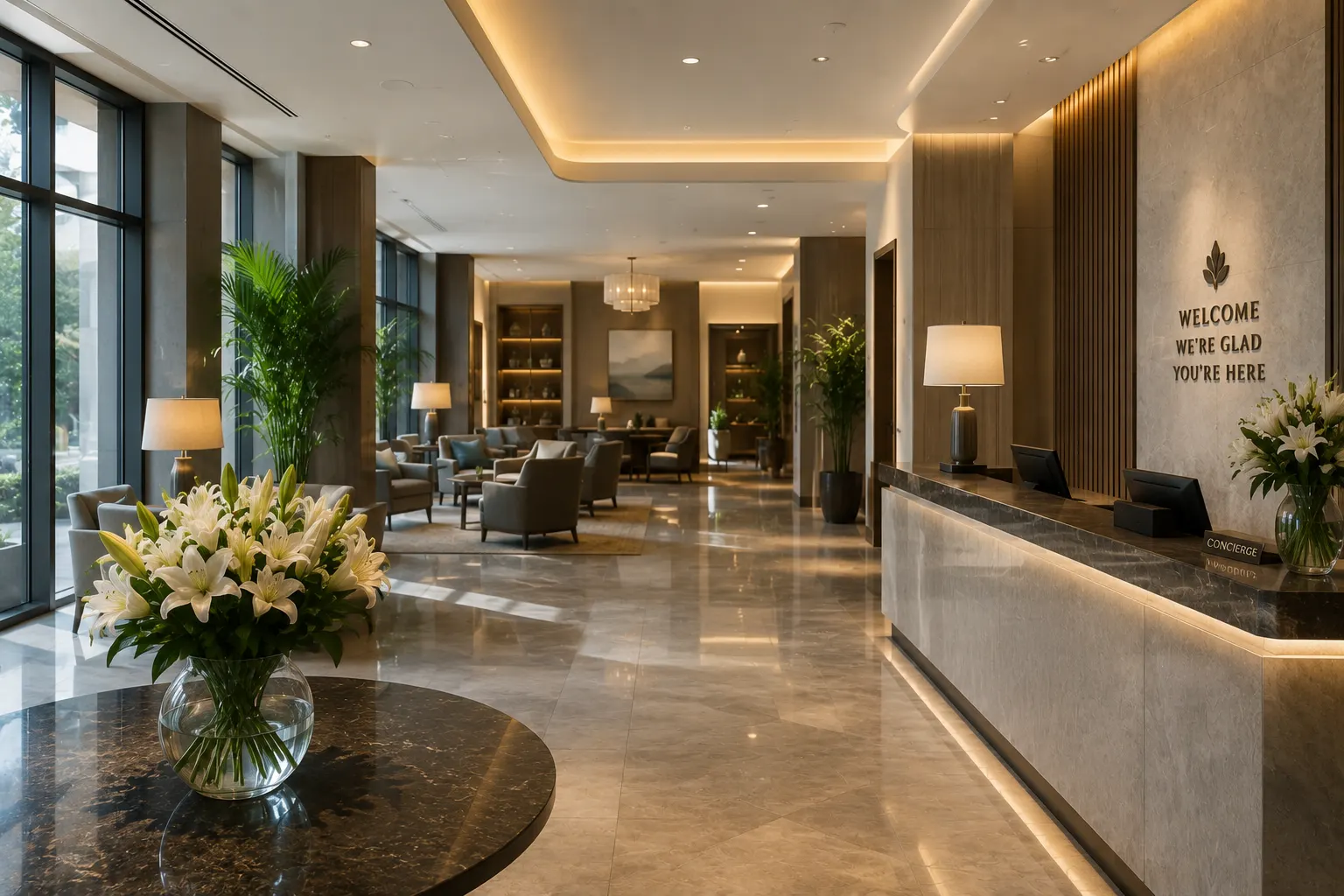
Key takeaways
- Hotel scent marketing uses a chosen fragrance, often a signature scent, as a deliberate part of the guest experience — alongside architecture, lighting, music and service.
- Most hotels start with the arrival experience (entrance and lobby), then extend to corridors, lounges, bars, event spaces and spa areas.
- Each zone is treated on its own terms: intensity, schedule and sometimes fragrance differ between a lobby, a guest corridor and a spa.
- Large lobbies and connected public areas are often best served by HVAC scenting; boutique properties and individual zones by standalone diffusers.
- Hotel groups use one signature scent across properties, with equipment configured for each building so the experience stays consistent.
What is hotel scent marketing?
Hotel scent marketing is the deliberate use of fragrance as part of a hotel's guest experience and brand identity. Instead of the lobby smelling of whatever cleaning products or kitchen air happen to reach it, the property chooses a fragrance direction that suits its brand, delivers it through professional diffusion equipment, and keeps it consistent with ongoing service.
Many hotels develop or curate a signature scent — a fragrance guests come to associate with that property or brand. See Signature Scent for how that identity is developed.
Where do hotels use scent?
Hotels rarely scent every area the same way. A typical program is planned zone by zone:
| Hotel zone | Typical role of fragrance | Usual approach |
|---|---|---|
| Entrance and lobby | The first impression and the strongest expression of the property's scent identity | HVAC scenting for large or open lobbies; standalone units for smaller ones |
| Guest floors and corridors | A consistent, subtle presence between arrival and the room | Low intensity, often via HVAC where corridor air handling allows |
| Lounges, bars and event spaces | Supporting each space's own character | Zone-specific intensity and schedules |
| Spa and wellness areas | A distinct, calm atmosphere that complements the main scent | Often a separate fragrance, usually via standalone units |
| Back-of-house | Usually left unscented | — |
Guest rooms are handled with care. Many properties keep fragrance to public areas and corridors, because guests differ in how much scent they want in a private room.
Why do hotels invest in a signature scent?
Hotels invest in a signature scent because it adds a sensory layer to the brand that is recognisable and consistent. A property's visual identity — architecture, materials, lighting — is expensive and slow to change, and it varies between buildings in a portfolio. A fragrance can be the same in every property.
Smell is closely linked with memory and emotion, which is one reason a scent can become associated with a place. That association builds through consistency over time. Scent marketing should not be sold as a guaranteed driver of revenue or guest scores; its practical role is to make one more part of the guest environment deliberate.
How is a hotel's scent chosen?
A hotel scent is chosen through brand discovery rather than personal preference. The process considers:
- The property's positioning and guest profile — a city business hotel and a beach resort call for different fragrance territories
- Architecture, interior materials and location
- How the scent should feel on arrival, and how long it should linger
- Whether the fragrance must work across several properties
- Any areas that need a distinct or gentler treatment, such as a spa
Candidate fragrances are then tested in the real environment, because a scent behaves differently in a large air-conditioned lobby than on a sample strip.
Which scent technology suits hotels?
Hotels generally use a mix of two approaches:
- HVAC scenting — fragrance distributed through the building's air handling. It suits resort-scale lobbies, atriums and connected public areas, gives more even coverage across large spaces, and keeps equipment out of guest sightlines.
- Standalone diffusion — individual units for boutique properties, spa receptions, meeting suites, or zones the ductwork doesn't serve separately.
The right mix comes from a site assessment of the property's layout and HVAC system, not a fixed rule. See Commercial Scent Systems for both options.
How strong should hotel fragrance be?
Hotel fragrance should be noticeable on arrival and subtle everywhere else. Intensity is calibrated per zone — higher in a large, high-ceilinged lobby with constant door traffic, lower in corridors — and scheduled around occupancy, check-in peaks and quiet hours. It is refined after installation, once the scent can be experienced in real conditions.
How do hotel groups keep the scent consistent across properties?
Hotel groups keep one signature fragrance across every property while configuring equipment, intensity and schedules for each building, because no two properties share the same layout or HVAC system. Consistency also depends on reliable replenishment and service at every site. Smart Scent Management covers how scheduling and intensity are coordinated across a portfolio.
Frequently asked questions
Where should a hotel start with scent marketing? Most hotels start with the entrance and lobby, where the fragrance makes the strongest first impression, then extend to corridors, lounges and spa areas once the lobby scent is established.
Should hotel guest rooms be scented? Many hotels keep fragrance to public areas and corridors and leave guest rooms unscented or very lightly scented, because guests' preferences in a private room vary. It is a decision made property by property.
Can a hotel spa use a different scent from the lobby? Yes. Spas often use a distinct fragrance that complements the main property scent, usually delivered by standalone units so it doesn't mix with the lobby's air.
Does Scent Up work with hotels in Thailand, the Philippines and Malaysia? Yes. Scent Up plans, installs and services scent programs for hotels and resorts across Thailand, the Philippines and Malaysia.
Next steps
See Hotels & Resorts for deployment by zone, How to Scent Large Commercial Spaces for large lobbies and atriums, or book a scent consultation to discuss a specific property or portfolio.