
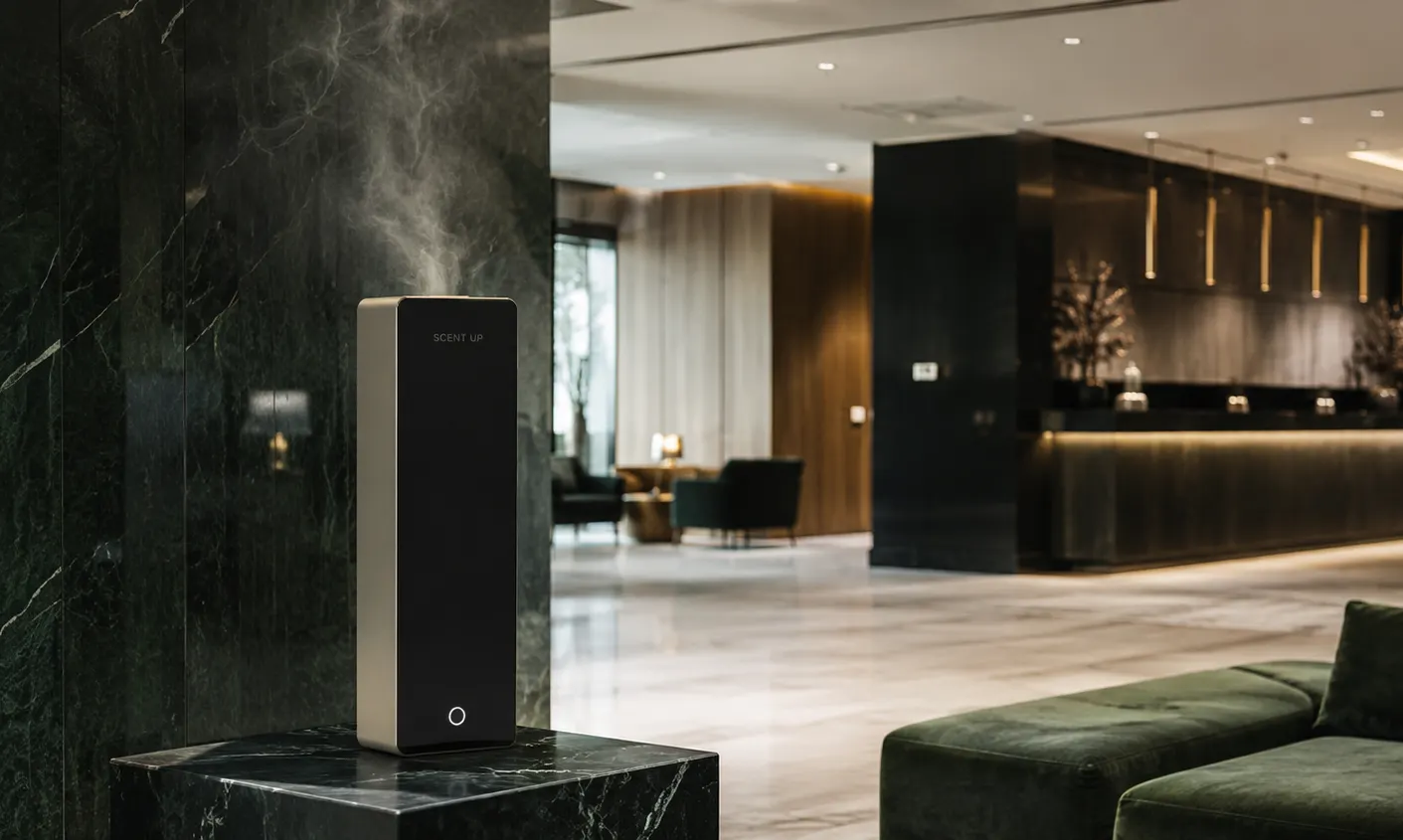
Scent marketing is the deliberate use of fragrance within a commercial environment to support the atmosphere, identity or intended experience of a brand or space. It combines fragrance strategy with the technology and operational planning needed to distribute that fragrance consistently — so the way a space smells is designed, rather than left to cleaning products, the street outside or incidental odours.
Key takeaways
- Scent marketing (also called scent branding, aroma marketing or olfactory marketing) treats fragrance as part of a brand's physical environment, alongside design, lighting, music and service.
- A program has four parts: strategy, fragrance, diffusion technology and ongoing service.
- Businesses choose an existing fragrance or develop a signature scent that becomes associated with their brand.
- Fragrance is delivered by standalone diffusers or HVAC scenting, sized to the space's air volume and airflow, and often divided into scent zones.
- It is not the same as an air freshener or odour control, and it should not be sold with guaranteed sales or behaviour claims.
What Is Scent Marketing?
Businesses carefully design how their brands look: logos, colour palettes, signage, lighting, materials and interior design are all chosen to communicate an identity. Music and service are often planned too. How a space smells is the element most often left unmanaged — scent marketing closes that gap.
A professional scent marketing program can involve:
- Understanding the brand and environment
- Selecting or developing a fragrance
- Identifying where fragrance should be experienced
- Choosing appropriate diffusion technology
- Configuring fragrance intensity
- Creating operating schedules
- Maintaining equipment
- Replenishing fragrance
- Adjusting the program over time
This is what distinguishes commercial scent marketing from simply placing an air freshener or scented product inside a room.
Scent Marketing vs Simply Making a Space Smell Nice
A pleasant-smelling environment and a scent marketing program are not necessarily the same thing.
A business might use a candle, room spray or air freshener because the fragrance smells pleasant.
Scent marketing begins with a different question:
What fragrance direction belongs in this particular brand environment?
That can involve considering:
- Brand positioning
- Interior design
- Materials and colours
- Customer environment
- Type of business
- Desired atmosphere
- Existing sensory identity
- Locations where the fragrance will be used
The fragrance is then paired with a diffusion approach capable of delivering it appropriately throughout the intended space.
The difference is therefore intent, consistency and implementation.
| Scent marketing | Air freshener | Odour control | |
|---|---|---|---|
| Purpose | Make fragrance a deliberate part of the brand environment | Make one area smell pleasant | Remove or reduce unwanted smells |
| Fragrance choice | Chosen or developed to fit the brand and space | Chosen by personal preference | Not the goal — neutralising is |
| Delivery | Professional diffusers or HVAC scenting, sized to the space | Sprays, plug-ins, candles, small units | Ventilation, cleaning, filtration, treatment at the source |
| Consistency | Scheduled, calibrated and serviced; the same across locations | Varies with the product and placement | Depends on the source being fixed |
| Scale | From one room to a whole building or a network of sites | Usually one room or spot | Wherever the odour problem is |
How Does Scent Marketing Work?
A commercial scent marketing program can be understood through four connected components:
1. Strategy
Before selecting equipment or fragrance, the business and physical environment should be understood.
The strategy can consider questions such as:
- What does the brand represent?
- Who uses the space?
- What atmosphere is appropriate?
- Where should fragrance be experienced?
- Are there areas that should remain unscented?
- Is this one property or a network of locations?
These answers establish the direction for the rest of the program.
2. Fragrance
Once the intended experience is understood, an appropriate fragrance direction can be selected or developed.
Some businesses choose from an existing fragrance collection.
Others develop a Signature Scent designed specifically around their brand identity.
The objective is not necessarily to select the strongest or most distinctive fragrance. The scent needs to complement the environment where it will actually be experienced.
3. Technology
The fragrance then needs to be distributed through the physical space.
Professional commercial scent systems are selected according to factors such as:
- Space size
- Ceiling height
- Air volume
- Layout
- Airflow
- HVAC infrastructure
- Number of scent zones
- Operating hours
A smaller independent space may use standalone diffusion, while a large or connected environment may require several scent zones, HVAC scenting or a combination of technologies.
4. Ongoing Service
Commercial scenting continues after installation.
Fragrance needs replenishment, equipment requires maintenance and operating settings may need adjustment as real-world conditions change.
Ongoing management can include:
- Fragrance replenishment
- Equipment inspection
- Intensity adjustments
- Schedule changes
- Maintenance
- Troubleshooting
- Periodic reassessment
A scent program should therefore be considered an ongoing part of the physical environment rather than simply a one-time equipment installation.
What Is a Signature Scent?
A signature scent is a fragrance selected or developed to represent a particular brand, property or environment.
Instead of choosing fragrance solely according to personal preference, the development process can consider the identity the business wants to communicate.
For example, fragrance direction might be influenced by:
- Brand personality
- Architecture
- Interior materials
- Location
- Customer profile
- Desired atmosphere
- Existing visual identity
Once established, the same fragrance can potentially be deployed across multiple properties while the equipment configuration is adapted to each individual location.
This allows fragrance to function as a consistent sensory element without assuming every building operates in exactly the same way.
Where Do Businesses Use Scent Marketing?
Scent marketing can be used in many types of customer-facing commercial environments.
Hotels and Resorts
Hospitality properties may incorporate fragrance into entrances, lobbies, corridors, lounges, spas and selected public areas.
Some hotels use a consistent signature fragrance as part of the property's wider sensory identity.
Read our Hotel Scent Marketing Guide or explore Hotels & Resorts.
Retail Stores and Shopping Centres
Retailers can incorporate fragrance alongside visual merchandising, lighting, music and store design.
For multi-location brands, the challenge expands from scenting one store to maintaining a recognizable fragrance experience across a network.
Read our Retail Scent Marketing Guide or explore Retail & Shopping Centres.
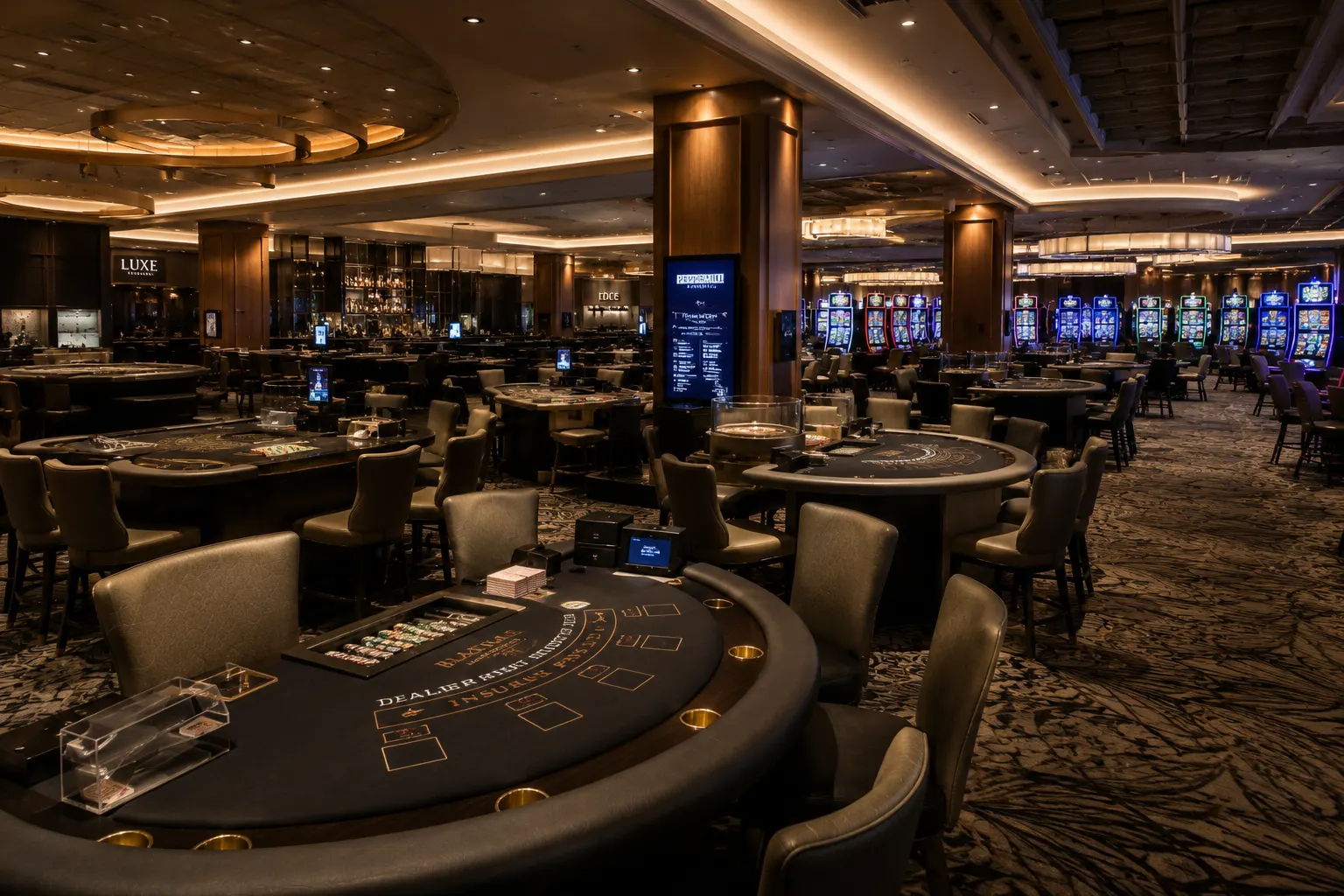
Casinos and Entertainment Venues
Large entertainment environments can require careful attention to airflow, scent zoning, operating schedules and diffusion technology.
Different areas of the property may need independent treatment depending on their function and air-handling infrastructure.
Read our Casino Scent Marketing Guide or explore Casinos & Entertainment.
Corporate Offices
Businesses can use fragrance selectively in reception areas, customer lounges, meeting spaces and other appropriate client-facing environments.
Explore Corporate & Offices for commercial applications.
Real Estate and Showrooms
Property developers and showroom operators can incorporate fragrance into sales galleries, show units, reception areas and other presentation environments.
Explore Real Estate & Showrooms.
Automotive Showrooms
Automotive dealerships can use fragrance across showrooms, reception areas, customer lounges and selected delivery environments.
For multi-location dealership networks, fragrance can also form part of a consistent physical brand identity.
Explore Automotive.
How Is Scent Distributed Through a Commercial Space?
Professional scent marketing requires a controlled method of fragrance diffusion.
The appropriate technology depends on the environment.
Standalone Scent Systems
Standalone systems can be suitable for:
- Individual rooms
- Retail stores
- Reception areas
- Independent scent zones
- Spaces without appropriate HVAC access
Equipment capacity and placement should still be matched to the environment rather than selected according to floor area alone.
HVAC Scenting
Larger or connected commercial spaces with suitable air-handling infrastructure may be candidates for HVAC-integrated scenting.
Instead of relying entirely on equipment distributed throughout customer-facing areas, fragrance can be introduced into selected parts of the building's air-handling infrastructure.
However, HVAC scenting is not automatically the correct solution for every large property.
Airflow, ductwork and HVAC zoning should be assessed first.
Read HVAC Scenting Explained for a detailed introduction.
What Is Scent Zoning?
Large properties often contain several environments with different functions.
A hotel, for example, may contain:
- Entrance
- Lobby
- Guest corridors
- Lounge
- Spa
- Event areas
Rather than assuming every area requires identical fragrance delivery, a scent program can divide the property into appropriate scent zones.
Different zones may use different:
- Intensity settings
- Schedules
- Equipment
- Diffusion methods
They do not necessarily need different fragrances.
A consistent signature fragrance can be maintained while its delivery is adjusted according to each environment.
How Strong Should Scent Marketing Be?
Commercial scenting is not about producing the strongest possible fragrance.
Intensity should be appropriate to the environment.
The correct setting can depend on:
- Space volume
- Airflow
- Operating hours
- Occupancy
- Diffusion method
- Desired fragrance presence
Simply increasing output can create strong fragrance close to equipment without solving uneven distribution elsewhere.
A professional program therefore focuses on controlled fragrance presence and consistent distribution, rather than maximum intensity.
How Many Scent Machines Does a Business Need?
There is no universal machine count based only on square metres or square feet.
A property with high ceilings and substantial air movement can behave very differently from an enclosed environment with the same floor area.
Equipment requirements can depend on:
- Total air volume
- Layout
- Ceiling height
- Airflow
- HVAC infrastructure
- Entrances
- Number of scent zones
Read How Many Scent Machines Does a Business Need? for a detailed explanation.
For larger properties, also see How to Scent Large Commercial Spaces.
Can Scent Marketing Work Across Multiple Locations?
Yes, but consistency requires more than sending the same fragrance to every branch.
Properties can differ significantly in size, airflow, HVAC infrastructure and operating conditions.
A multi-location scent program can therefore maintain the same fragrance identity while configuring equipment and settings individually for each property.
Operational considerations can include:
- Fragrance consistency
- Equipment configuration
- Operating schedules
- Intensity settings
- Replenishment
- Maintenance
- New location deployment
Smart Scent Management can support centralized oversight of multi-location scent programs.
How Much Does Scent Marketing Cost?
There is no universal price for commercial scent marketing.
Cost can depend on:
- Property size
- Equipment requirements
- Number of scent zones
- Diffusion technology
- Fragrance selection or development
- Installation
- Number of locations
- Ongoing fragrance supply
- Maintenance and service
A small independent retail space and a large hotel or shopping centre should not be expected to have the same requirements.
Read How Much Does Commercial Scent Marketing Cost? for a detailed breakdown.
Is Scent Marketing the Same as Odour Control?
Not necessarily.
Scent marketing and odour management can overlap in some environments, but they solve different problems.
Odour control focuses on identifying, reducing or managing unwanted odours.
Scent marketing focuses on deliberately introducing an appropriate fragrance as part of the intended commercial environment.
Adding stronger fragrance should not be treated as a substitute for addressing an underlying odour problem.
Where unwanted odours exist, their source should be understood rather than simply attempting to cover them with fragrance.
Does Scent Marketing Influence Memory and Emotion?
Smell is closely connected with brain systems involved in memory and emotion, which is one reason fragrance can become associated with places and experiences.
However, businesses should be cautious about turning that relationship into exaggerated marketing claims.
A scent program cannot guarantee that customers will spend more, stay longer, purchase more products or remember a brand in a particular measurable way.
Its practical role is to add another deliberately managed sensory element to the physical environment.
For businesses, that means fragrance can be considered alongside design, lighting, sound and service rather than being left entirely to chance.
Scent Marketing in Thailand, the Philippines and Malaysia
Scent Up runs scent marketing programs in three markets, each with local installation and service:
- Scent marketing in Thailand: from the Bangkok head office, for hotels, resorts, spas, retail stores and shopping centres in Bangkok, Nakhon Pathom and across the country.
- Scent marketing in the Philippines: from the Cebu City office, for hotels, malls, retail chains, casinos and offices in Cebu, Metro Manila and beyond.
- Scent marketing in Malaysia: for hotels, shopping centres, property sales galleries and automotive showrooms in Kuala Lumpur and across the country.
Each market page covers the local sectors, climate and building considerations, costs, and how a program is run there.
How to Start a Scent Marketing Program
A business considering scent marketing should begin with the environment and intended experience rather than immediately selecting a scent machine.
Start by asking:
- What should the environment communicate?
- Which areas should be scented?
- Who uses those spaces?
- Is an existing fragrance appropriate or is a signature scent required?
- How large are the intended scent areas?
- How does air move through the property?
- What HVAC infrastructure is available?
- Does the property require several scent zones?
- How will fragrance replenishment and servicing be managed?
- Will the program eventually expand to additional locations?
Once those requirements are understood, fragrance direction, diffusion technology and deployment can be planned around the actual property.
Build a Scent Strategy for Your Business
Scent marketing is most effective when strategy, fragrance, technology and ongoing management work together.
The starting point is not simply choosing which scent smells best or which machine has the largest coverage specification.
It is understanding the brand, the physical environment and the experience the fragrance is intended to support.
Use our Scent Solution Finder for an initial technology direction, or book a consultation to discuss your business and property.