
Key takeaways
- There is no reliable machine count based on floor area alone; the same footprint can need very different equipment.
- The main factors are total air volume (floor area × ceiling height), airflow, layout, entrances and door traffic, HVAC infrastructure and the number of scent zones.
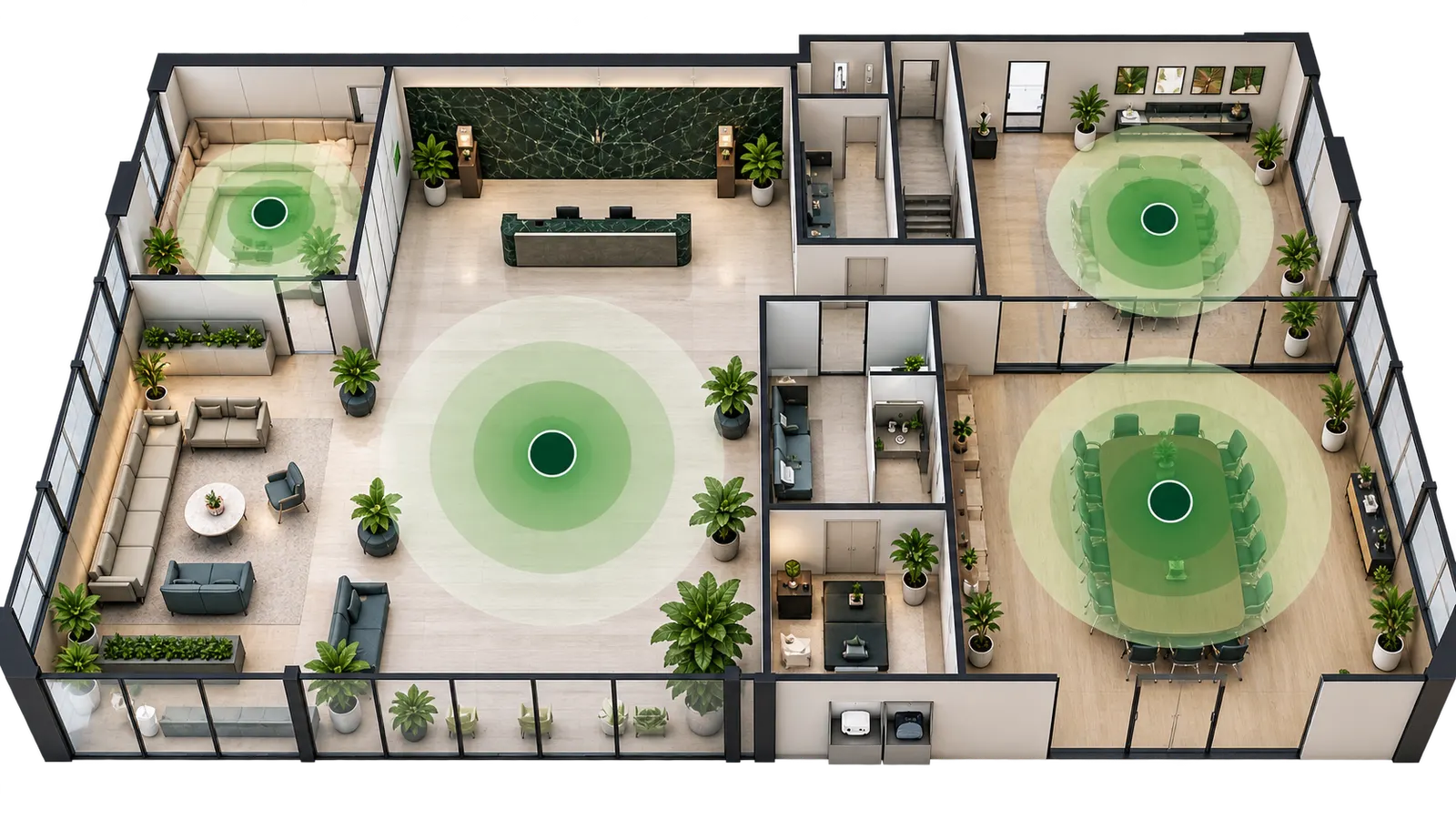
- Small, enclosed spaces often need one appropriately sized standalone unit; large or open spaces usually need several units or HVAC scenting.
- In large connected buildings, one HVAC-integrated system can replace many standalone machines, so the question becomes where fragrance is introduced, not how many machines.
- Multi-location businesses should have each site assessed, because identical equipment in different buildings gives different results.
How many scent machines does a business need?
The number of scent machines a business needs depends on the space, not just its size. A small shop with a standard ceiling may need a single appropriately sized unit. A large hotel lobby, mall concourse or casino floor may need several units placed across the space, or an HVAC scenting system instead of individual machines. The only reliable way to get a number is an assessment of the actual space.
Online calculators that convert square metres into a machine count ignore the factors that matter most, so treat their results as a rough starting point at best.
Why floor area alone doesn't give the answer
Two spaces with the same floor area can behave completely differently for fragrance:
- A room with a 3-metre ceiling holds far less air than the same footprint with a 6-metre atrium, so the atrium needs more fragrance output to reach the same presence.
- An open-fronted store facing a busy mall concourse loses fragrance constantly; a closed, air-conditioned boutique holds it.
- An open-plan floor lets fragrance spread; a space divided by walls and partitions needs output in each section.
That is why equipment is specified against air volume and airflow, not square metres.
What determines the number of scent machines?
| Factor | Why it matters |
|---|---|
| Air volume (floor area × ceiling height) | Fragrance has to reach the whole volume of air, not just the floor |
| Airflow and ventilation | How air moves decides where fragrance travels and how quickly it dissipates |
| Layout and partitions | Separate rooms or sections usually each need their own output |
| Entrances and door traffic | Frequently opened doors and open shopfronts let fragrance escape |
| HVAC infrastructure | A suitable central system can distribute fragrance for the whole area |
| Number of scent zones | Areas that need their own intensity, schedule or fragrance need their own control |
| Operating hours and occupancy | Longer hours and busy periods affect output settings and fragrance use |
Standalone machines vs HVAC scenting
The question changes depending on the delivery method:
- Standalone scent machines are placed in or near the space. For smaller or separate spaces the question really is "how many units, and where" — and placement matters as much as the count, since a badly placed unit gives a strong spot and weak coverage elsewhere.
- HVAC scenting connects a diffusion unit to the building's air handling. In large or connected buildings it can replace many standalone units with one centrally distributed system. The planning then focuses on ductwork, zoning and where fragrance enters the air stream.
Many businesses use both: HVAC scenting for large public areas, standalone units for rooms the ductwork doesn't serve separately.
Typical starting points by type of space
These are general directions, not specifications — every space still needs an assessment.
| Type of space | Typical starting point |
|---|---|
| Small boutique, clinic reception or meeting room | One suitably sized standalone unit, carefully placed |
| Larger store, showroom or restaurant with several areas | Several standalone units, one per area or zone |
| Hotel lobby, atrium or mall concourse | HVAC scenting, or several larger standalone units where HVAC isn't suitable |
| Casino floor or large multi-zone property | HVAC scenting across connected areas, plus standalone units for separate zones |
Is more machines (or a higher setting) better?
No. Adding machines or turning up output does not fix poor coverage — it tends to create strong fragrance close to each unit while other areas stay weak, and it uses more fragrance. Even coverage comes from the right equipment in the right places, calibrated to the space, then adjusted after installation.
What about businesses with several locations?
Each location should be assessed individually. Branches that look alike often differ in ceiling height, HVAC and door traffic, so copying one site's equipment to another rarely gives the same result. The fragrance stays the same everywhere; the equipment and settings are configured per site. See Smart Scent Management.
Frequently asked questions
Can one scent machine cover a whole store? In a small, enclosed store with a standard ceiling, one appropriately sized unit is often enough. Larger or more open stores usually need several units or HVAC scenting.
How much area does one scent machine cover? It depends on the machine's capacity and the space's air volume and airflow, so there is no single coverage figure that applies everywhere. Manufacturer coverage figures assume ideal conditions and should be checked against the real space.
Does HVAC scenting mean only one machine? Often one HVAC-connected unit serves a large connected area, but buildings with several air handling units or separate zones may need more than one.
Get a recommendation for your space
Try the Scent Solution Finder for a general direction, read How to Scent Large Commercial Spaces and Commercial Scent Machines: What Businesses Should Know, or book a scent consultation for an assessment that produces an actual equipment recommendation.