
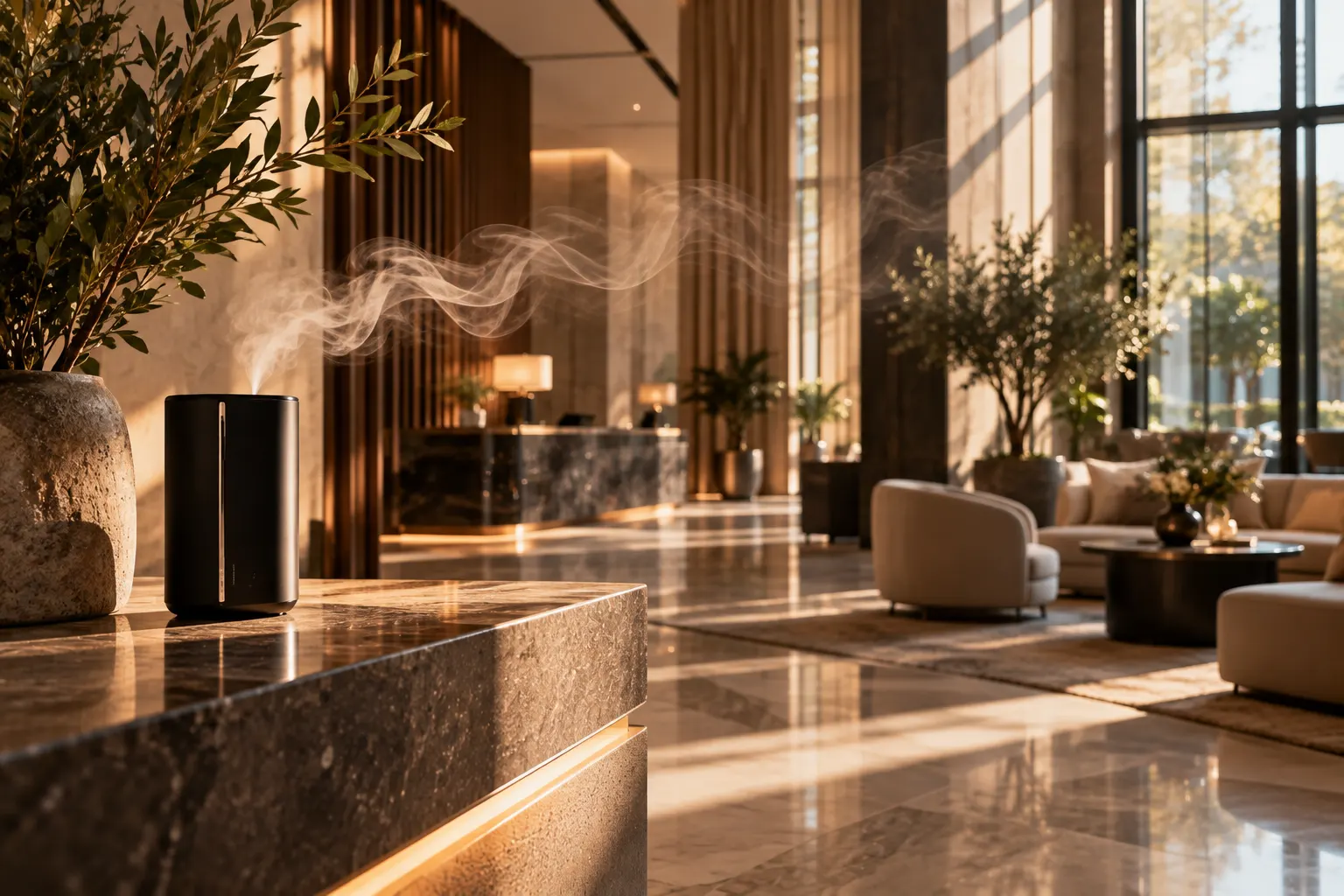
A scent marketing diffuser is commercial fragrance diffusion equipment used to scent a business space consistently, at a controlled intensity and on a schedule. There are two broad types: standalone diffusers, placed in or near the space, and HVAC-connected diffusers, which release fragrance into the building's air handling so it travels through the ductwork. Placement matters as much as the model: the same diffuser can give even coverage in one position and a strong spot with weak surroundings in another.
Key takeaways
- Standalone diffusers suit contained spaces and separate zones; HVAC-connected diffusers suit large or connected areas where the building's air handling is suitable.
- Place standalone diffusers where air carries fragrance into the space — often near air movement and away from doors, food, and direct seating.
- Size the diffuser to the space's air volume and airflow, not the floor area alone.
- Intensity and scheduling controls matter for commercial use; fragrance should be noticeable, never overpowering.
- Placement is refined after installation, once the scent can be experienced in real conditions.
What types of scent marketing diffusers are there?
| Type | How it works | Typical use |
|---|---|---|
| Standalone (wall-mounted or freestanding) | Placed in or near the space; releases fragrance directly into the room | Stores, receptions, clinics, meeting rooms, spa rooms, single zones |
| Larger standalone units | Higher-capacity units for bigger open areas | Showrooms, restaurants, larger stores, smaller lobbies |
| HVAC-connected | Installed with the air handling; releases fragrance into the air stream | Hotel lobbies, atriums, malls, casino floors, connected multi-zone areas |
Many properties combine them — HVAC scenting for the large shared areas, standalone diffusers for rooms the ductwork doesn't serve separately. For a broader look at the equipment, read Commercial Scent Machines: What Businesses Should Know.
Where should a scent diffuser be placed?
General placement principles for standalone diffusers:
- Work with the airflow. Positions where air moves gently through the space help carry fragrance evenly; dead corners hold it in one place.
- Mind the entrance. Fragrance near an open door or open shopfront is quickly lost; placing a unit slightly inside the space, where visitors pause, usually works better.
- Keep clear of food and dining tables. In restaurants and cafés, scent entrances, bars or lounges rather than directly over dining areas.
- Avoid direct seating and workstations. People sitting right next to a diffuser experience a much stronger scent than everyone else.
- Think about height and obstruction. Shelving, partitions and high ceilings all change how fragrance spreads.
- Allow for service access. Units need to be reached for refills and maintenance without disrupting customers.
For HVAC-connected diffusers, "placement" means choosing where fragrance enters the air handling — decided during an assessment of the ductwork and zones. See HVAC Scenting Explained.
Placement by type of space
| Space | Placement approach |
|---|---|
| Retail store | Just inside the entrance zone and across the main sales floor; separate units for large or divided stores |
| Hotel lobby | HVAC-connected for large lobbies; otherwise units positioned with the lobby's airflow, away from the entrance doors |
| Showroom or sales gallery | Across the display floor and reception; lighter in consultation rooms |
| Restaurant | Entrance, bar and lounge areas rather than dining tables |
| Office reception | Reception and client-facing meeting areas, not open-plan workstations |
| Spa or clinic reception | Low intensity in reception and waiting areas |
How do you choose the right diffuser?
- Measure the air, not just the floor. Air volume (floor area × ceiling height) and airflow decide the capacity needed.
- Decide the zones. Separate areas with different needs usually need separate units or separate HVAC zones.
- Check the HVAC option. For large connected spaces, assess whether the air handling is suitable before adding many standalone units.
- Look for commercial controls. Adjustable intensity and scheduling by day and time.
- Plan the service. Who refills and maintains the diffusers, and how often?
Read How Many Scent Machines Does a Business Need? for sizing.
Frequently asked questions
What is the best scent diffuser for a business? The best scent diffuser for a business is the one sized and placed for its space: standalone units for contained areas, HVAC-connected units for large connected areas. There is no single best model for every space.
How strong should a commercial diffuser be set? Noticeable on arrival, never overpowering. Intensity is calibrated to each zone's size and airflow and adjusted after installation.
Can one diffuser scent a whole store? In a small, enclosed store, often yes. Larger or open stores usually need several units or HVAC scenting.
Next steps
Compare options in Commercial Scent Systems, try the Scent Solution Finder, or book a scent consultation for placement advice for your space.