
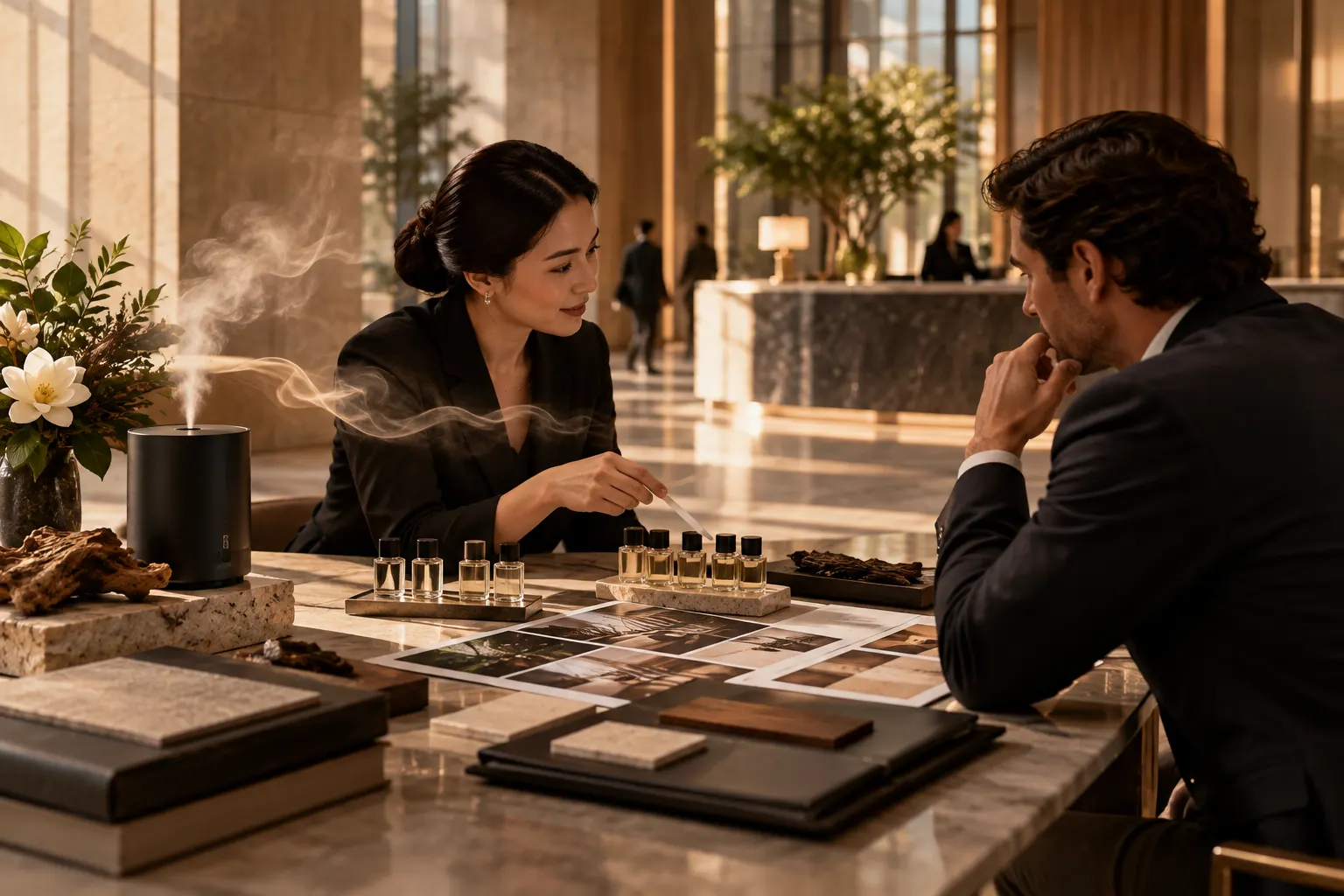
Choose a scent marketing company by how it works, not just by its fragrances or machines. A good scent marketing or scent branding company assesses your space before recommending equipment, helps you choose or develop a fragrance that fits your brand, offers the right technology for each area (standalone diffusers, HVAC scenting or both), installs it, and then services it — replenishing fragrance and adjusting intensity and schedules over time. It quotes clearly and avoids promises it can't prove.
Key takeaways
- A scent marketing company should cover strategy, fragrance, technology, installation and ongoing service — not just sell a machine and refills.
- Insist on a site assessment: equipment recommended from floor area alone is a warning sign.
- Ask whether the provider offers both standalone and HVAC scenting, so the recommendation fits the space rather than the provider's catalogue.
- Check who services the system, how often, and what happens across multiple locations.
- Be cautious of guaranteed sales, dwell-time or behaviour claims; no provider can promise those.
What does a scent marketing company do?
A scent marketing company plans, supplies and runs a business's fragrance program. In practice that covers:
| Stage | What a good provider does |
|---|---|
| Strategy | Understands the brand, the spaces and which areas should (and shouldn't) be scented |
| Fragrance | Offers suitable existing fragrances and, where needed, develops a signature scent |
| Assessment | Reviews size, ceiling height, airflow, HVAC, entrances and zones before specifying equipment |
| Technology | Recommends standalone diffusers, HVAC scenting or a combination, sized to the space |
| Installation | Installs, configures intensity and schedules, and tests in real conditions |
| Service | Replenishes fragrance, maintains equipment and adjusts settings over time |
| Multi-site | Keeps the same scent consistent across every location |
12 questions to ask a scent marketing company
- Will you assess our space before recommending equipment? The answer should be yes — and the assessment should look at air volume, airflow and HVAC, not just floor area.
- Do you offer both standalone diffusers and HVAC scenting? A provider with only one option may recommend it whether or not it suits the space.
- How will you decide which areas to scent? Expect a zone-by-zone answer, including areas to leave unscented.
- Can we choose from existing fragrances, and can you develop a signature scent? Understand both routes and their implications for cost and timing.
- Can we test the fragrance in our own space? A scent behaves differently in a real lobby or store than on a sample strip.
- How is intensity controlled and scheduled? Look for per-zone intensity settings and schedules around opening hours.
- Who installs the equipment, and who services it afterwards? Local installation and servicing matter, especially across several sites.
- How often will fragrance be replenished, and who tracks it? The service plan should make this the provider's job, not your staff's.
- What happens if coverage is uneven after installation? A good provider adjusts placement and settings rather than just turning output up.
- Can you keep one scent consistent across all our locations? Ask how equipment and settings are configured per site.
- Is the equipment rented or purchased, and what does the fee include? Compare fragrance supply, maintenance and contract terms, not just the equipment price. See Scent Machine Rental vs Purchase.
- What results do you claim, and on what basis? Be wary of guaranteed sales increases or behaviour changes.
Red flags when comparing scent marketing providers
- Equipment quoted from square metres alone, with no questions about ceiling height, airflow or HVAC.
- "More output" as the answer to every coverage problem — that creates strong spots and weak areas, and wastes fragrance.
- No clear service plan for replenishment, maintenance and adjustments.
- Guaranteed commercial outcomes, such as a promised percentage increase in sales or time spent in store.
- Medical or therapeutic claims for spas, clinics or offices — scent in those settings is about atmosphere.
- Unclear pricing that separates the machine from the fragrance supply and service without saying so.
How to compare proposals fairly
Put each proposal side by side on the same items:
- Areas and zones covered
- Equipment type, number and placement
- Fragrance (existing or signature) and testing
- Installation and configuration
- Replenishment frequency and service visits
- Contract length, rental or purchase terms
- Total cost over the expected period, not just the upfront figure
Read How Much Does Commercial Scent Marketing Cost? for what drives price.
Frequently asked questions
What is the difference between a scent marketing company and a diffuser supplier? A diffuser supplier sells equipment and fragrance. A scent marketing company plans the whole program — strategy, fragrance, assessment, installation and ongoing service — so the scent works in the space and stays consistent.
Should a scent marketing company visit the site? Yes, for anything beyond a very small single room. The site's air volume, airflow and HVAC decide the right equipment, and those can't be judged from a floor plan alone.
Does Scent Up offer these services? Yes. Scent Up covers strategy, fragrance selection and signature scent development, standalone and HVAC scent systems, installation and ongoing service for businesses in Thailand, the Philippines and Malaysia.
Next steps
Explore Scent Marketing to see how Scent Up approaches a program, read the FAQ, or book a scent consultation.