
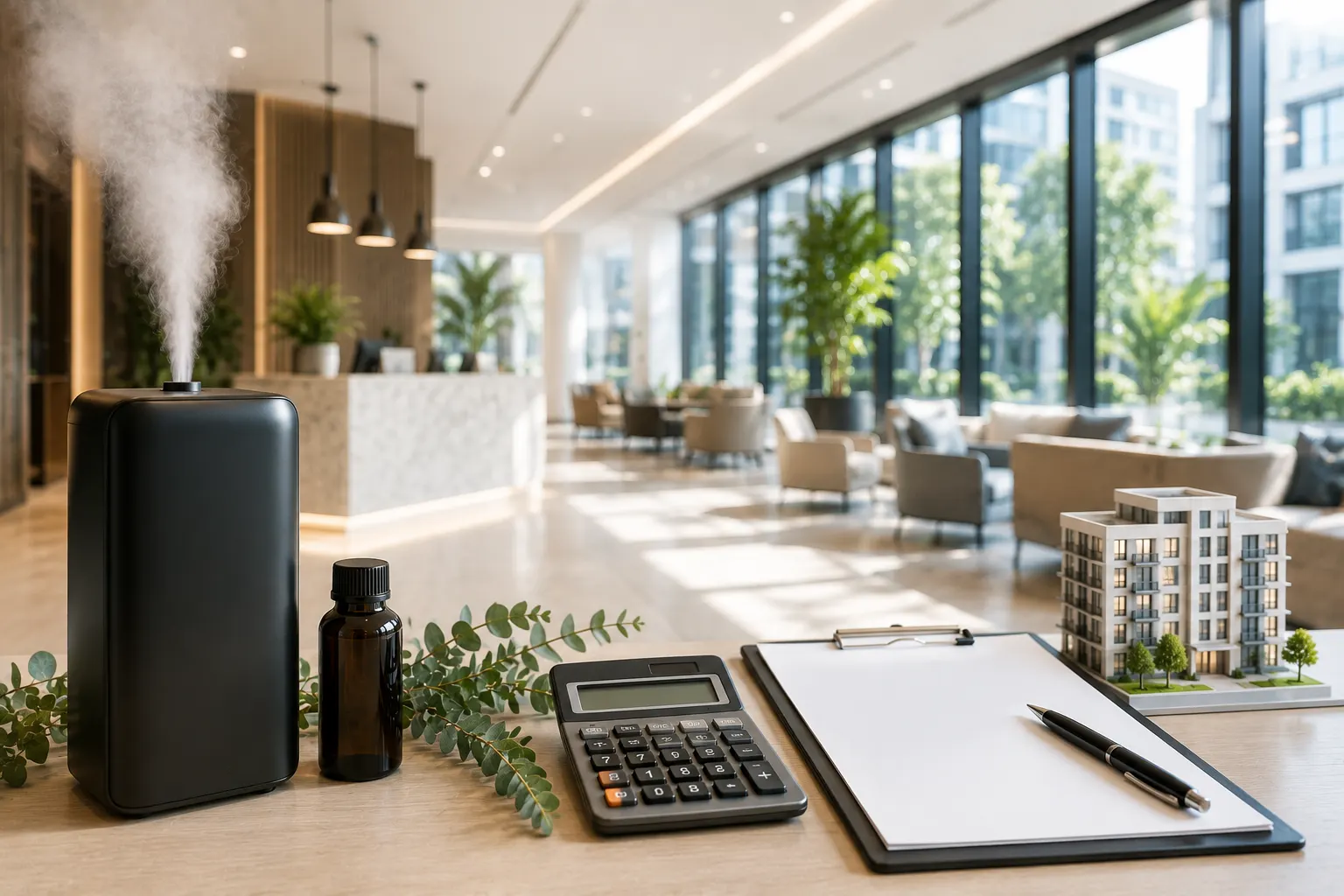
Commercial scent marketing has no single price: the cost depends on the space being scented, the equipment it needs, the fragrance, the number of locations and the level of ongoing service. A small shop with one standalone diffuser and an existing fragrance sits at the lower end; a hotel, casino or shopping centre with several zones, HVAC scenting and a custom signature scent sits much higher.
Key takeaways
- The biggest cost drivers are air volume and layout, the number of scent zones, standalone vs HVAC equipment, and fragrance choice (existing vs signature scent).
- Separate initial costs (assessment, equipment, installation, fragrance development) from ongoing costs (fragrance replenishment, servicing, maintenance).
- Renting or buying equipment changes how costs are structured, not automatically how much the program costs overall.
- Two properties with the same floor area can need different systems, which is why reliable quotes follow a site assessment.
- A good quote states exactly what equipment, fragrance supply and service are included.
Cost Drivers at a Glance
| Cost factor | Lower-cost end | Higher-cost end |
|---|---|---|
| Space | One small, enclosed room | Large, high-ceilinged or open-plan areas |
| Scent zones | A single zone | Several zones with separate settings |
| Equipment | One standalone diffuser | Several units or HVAC scenting |
| Fragrance | An existing fragrance | A custom signature scent |
| Locations | One site | A network of sites |
| Service | Basic replenishment | Full management: refills, maintenance, adjustments |
One of the first questions businesses ask when considering scent marketing is how much it costs. There isn't one price that applies to every property.
The cost of a professional scent marketing program depends on the environment being scented, the diffusion technology required, fragrance selection or development, the number of locations involved and the level of ongoing service.
A small independent commercial space has very different requirements from a hotel, casino, shopping centre or multi-property portfolio.
Understanding these variables makes it easier to evaluate a proposal and understand what you are actually paying for.
What Determines Commercial Scent Marketing Cost?
Several factors can influence the initial and ongoing cost of a commercial scenting program.
1. Space Size, Volume and Layout
The physical environment is one of the most important factors.
Larger spaces may require higher-capacity equipment, multiple scent zones or a different diffusion approach.
Floor area alone does not tell the complete story. Ceiling height, open entrances, connected spaces and airflow can significantly affect system requirements.
A large open lobby, for example, may require a different approach from several smaller rooms with the same combined floor area.
For a deeper explanation, see How to Scent Large Commercial Spaces.
2. Type of Scent Diffusion System
Equipment requirements have a direct effect on project cost.
Commercial properties generally use standalone diffusion equipment, HVAC-integrated systems or a combination of both.
Standalone scent machines can work well for independent rooms, smaller commercial spaces and areas requiring individual control.
HVAC-integrated scenting may be appropriate for larger or connected environments where the existing air-handling infrastructure can support centralized fragrance distribution.
The right choice should be based on the property rather than simply selecting whichever equipment has the lowest initial price.
Explore our commercial scent systems to understand the different approaches.
3. Number of Scent Zones
A property does not always operate as one fragrance zone.
Hotels, casinos, shopping centres and other large commercial environments may require different scent settings across entrances, lobbies, corridors, lounges, wellness areas or other spaces.
Additional independent zones can affect:
- Equipment requirements
- Installation
- Fragrance consumption
- Scheduling
- System configuration
- Ongoing servicing
The objective is not to create as many zones as possible, but to provide the appropriate level of control for the property.
4. Fragrance Selection or Signature Scent Development
Fragrance scope can also affect the overall investment.
Selecting an appropriate fragrance from an existing collection is different from developing a bespoke fragrance identity specifically for a brand.
A custom Signature Scent can involve brand discovery, fragrance direction, evaluation and refinement before the final scent is deployed.
Whether custom fragrance development is necessary depends on the role scent is expected to play within the brand experience.
5. Number of Locations
A single-property deployment and a regional multi-location program have different requirements.
Businesses operating hotels, retail stores, offices or other locations may need to account for equipment and fragrance at each property while also maintaining consistency across the portfolio.
Individual locations may require different equipment configurations even when they use the same fragrance.
Smart Scent Management can support centralized scheduling and system oversight while allowing each property's scenting configuration to reflect its actual environment.
6. Installation Requirements
Installation complexity depends on the selected equipment and the property itself.
A standalone system may require relatively straightforward placement, while an HVAC-integrated installation can involve assessment of air-handling zones, ductwork and suitable fragrance injection locations.
Accessibility, electrical requirements and coordination with property engineering or facilities teams can also influence project scope.
7. Fragrance Consumption
Fragrance is an ongoing operating cost rather than simply part of the initial installation.
Consumption can vary according to:
- Operating hours
- Diffusion settings
- Number of scent zones
- Equipment type
- Air volume
- Desired fragrance intensity
- Environmental conditions
A property operating eight hours per day may have different consumption requirements from a hotel or casino operating continuously.
8. Maintenance and Ongoing Service
Commercial scenting should also account for what happens after installation.
Depending on the service model, ongoing support may include:
- Fragrance replenishment
- Equipment inspection
- Diffusion adjustments
- Schedule changes
- System maintenance
- Troubleshooting
- Performance monitoring
These services contribute to the total operating cost of maintaining a consistent fragrance experience.
Initial Cost vs Ongoing Scent Marketing Cost
When comparing scent marketing proposals, it helps to separate initial costs from ongoing costs.
Initial project costs may include equipment, installation, site assessment and any custom fragrance development.
Ongoing costs can include fragrance replenishment, servicing, maintenance and program management.
Looking only at the equipment price can therefore give an incomplete picture of the actual cost of running a commercial scent program.
The more useful comparison is the total scope of the program and what is included over time.
Should You Rent or Buy a Commercial Scent Machine?
Equipment ownership can also affect how scent marketing costs are structured.
Some businesses prefer purchasing equipment, while others may choose rental or managed-service arrangements that combine equipment with ongoing fragrance supply and servicing.
Neither model is automatically less expensive in every situation.
The right choice depends on the required equipment, expected service level, length of deployment and how much responsibility the business wants to manage internally.
Read Scent Machine Rental vs Purchase for a more detailed comparison.
Why Doesn't Scent Up Publish a Fixed Price List?
Commercial scent marketing is highly dependent on the property being treated.
Publishing a single price based only on square metres or square feet could create an unrealistic expectation before factors such as ceiling height, airflow, HVAC infrastructure and scent zoning are understood.
For example, two businesses occupying the same floor area could require different equipment because one has a high-ceilinged open lobby while the other consists of several enclosed rooms.
Instead of applying one generic price to every environment, the objective is to recommend a system based on the actual requirements of the property.
What Should a Commercial Scent Marketing Quote Include?
When comparing proposals, businesses should understand what is included rather than evaluating the headline price alone.
Depending on the project, a quote may address:
- Recommended diffusion system
- Number of systems or scent zones
- Installation requirements
- Fragrance selection or development
- Fragrance supply
- Expected replenishment
- Equipment servicing
- Scheduling and system configuration
- Ongoing management
- Multi-location requirements
This makes it easier to compare the actual scope of competing proposals rather than comparing equipment prices that may include very different levels of service.
What to Expect From a Scent Consultation
A consultation should establish enough information to recommend an appropriate fragrance and diffusion approach.
This can include the property's:
- Type of business
- Approximate size and ceiling height
- Layout
- HVAC infrastructure
- Number of desired scent zones
- Operating hours
- Fragrance direction
- Number of locations
Once these requirements are understood, an equipment and fragrance recommendation can be developed around the actual environment.
Get a Commercial Scent Marketing Quote
The most useful scent marketing price is one based on the property you actually need to scent.
For an initial technology direction, use our Scent Solution Finder.
If you are planning a scenting program for a hotel, casino, retail environment, office or other commercial property, book a consultation with Scent Up to discuss your space, fragrance requirements and recommended system.