
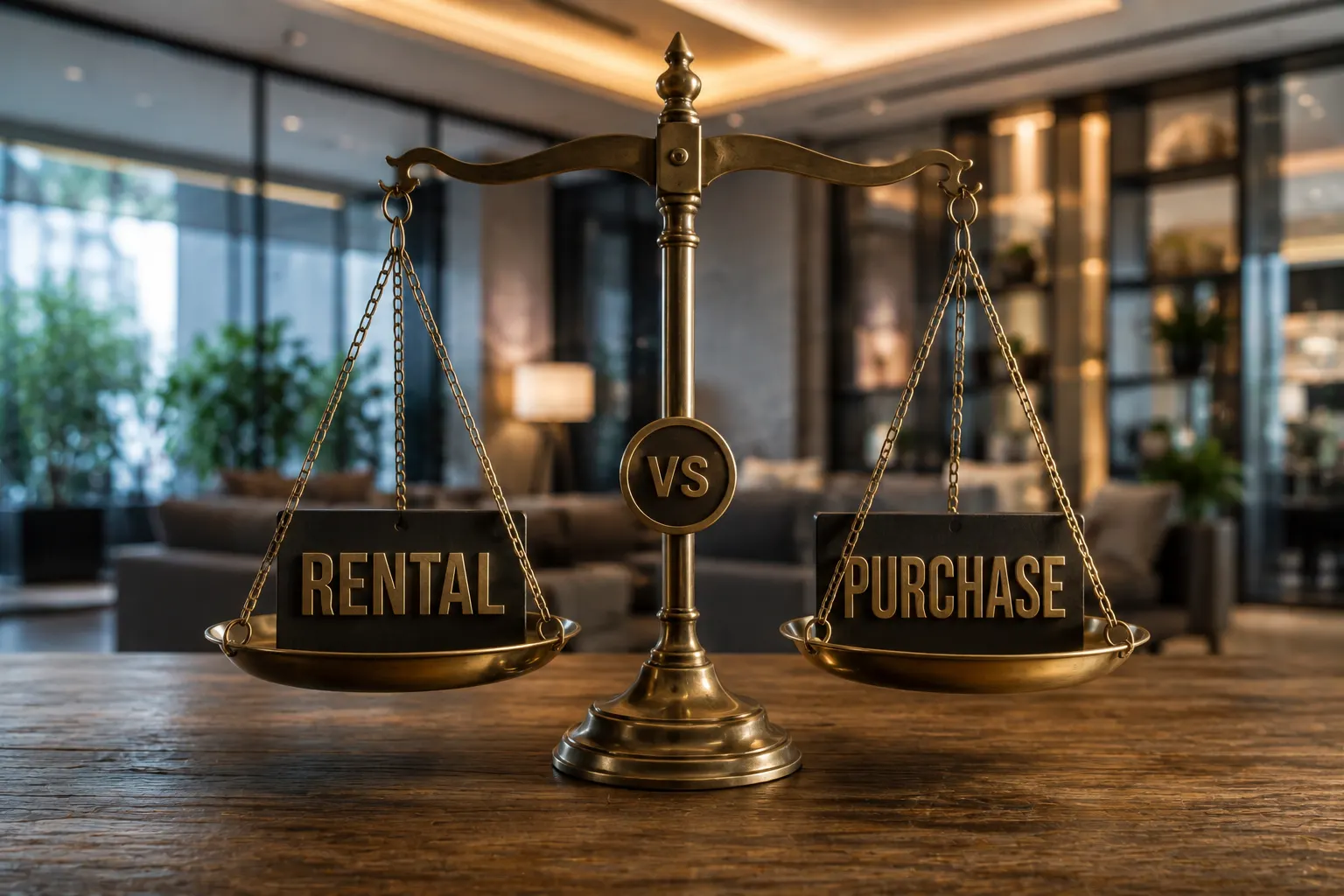
Renting a scent machine usually means lower upfront cost and a service arrangement managed by the provider; buying means owning the equipment and taking on more responsibility for maintenance. Neither is automatically cheaper over time — the better option depends on how the business prefers to budget, how long the installation will run, who should manage fragrance supply and servicing, and whether more locations are planned.
Key takeaways
- The core difference is ownership: with purchase the business owns the machine; with rental it stays under the provider's agreement.
- Compare total cost over the expected period, not just the upfront price.
- Fragrance supply and servicing are separate from equipment ownership — check who provides them under either model.
- Rental can suit temporary installations, uncertain requirements or businesses that want predictable recurring costs.
- Multi-location businesses should weigh consistency of service across sites as much as equipment cost.
Rental vs Purchase at a Glance
| Renting a scent machine | Buying a scent machine | |
|---|---|---|
| Upfront cost | Lower — typically a recurring fee | Higher — equipment is paid for up front |
| Ownership | Equipment stays under the provider's agreement | The business owns the equipment |
| Maintenance | Often included in the service arrangement | Depends on the service plan purchased |
| Flexibility | Easier to change or return equipment, within contract terms | Equipment stays with the business |
| Best fit | Temporary or evolving needs, predictable budgeting, provider-managed programs | Long-term installations, businesses preferring ownership |
| Check carefully | Contract length, what the fee includes, fragrance supply | Service plan, fragrance supply, replacement and repair |
Businesses investing in commercial scenting often face an early decision: Should you rent a scent machine or purchase the equipment outright?
The answer is not simply about which option has the lower initial price.
A commercial scent program involves more than the equipment itself. Fragrance replenishment, maintenance, operating schedules, intensity adjustments and ongoing support can all affect the total cost and workload over time.
Rental and purchase models can both work. The better option depends on your budget structure, property requirements, service expectations and how much of the scent program you want to manage internally.
Scent Machine Rental vs Purchase: What's the Difference?
The basic distinction is equipment ownership.
With a purchase model, the business buys the scent machine and owns the equipment according to the terms of the sale.
With a rental or lease model, the equipment remains subject to the provider's rental or leasing agreement while the business pays an ongoing fee.
However, ownership is only one part of the comparison.
Depending on the provider and contract, either model may also include separate arrangements for:
- Fragrance supply
- Installation
- Maintenance
- Equipment servicing
- Repairs
- Replacement equipment
- Scheduling
- Intensity adjustments
- Technical support
For that reason, businesses should compare the complete scope of each proposal rather than equipment ownership alone.
Buying a Commercial Scent Machine
Purchasing may appeal to businesses that prefer to own their equipment and separate the hardware investment from ongoing fragrance and service costs.
Potential advantages can include:
- Ownership of the equipment
- No continuing equipment rental fee after purchase
- Greater control over how long the equipment remains in use
- Potential suitability for long-term installations
- Easier treatment of the equipment as a capital purchase where applicable
However, purchasing equipment does not eliminate ongoing costs.
A commercial scent program may still require fragrance replenishment, maintenance, servicing and eventual equipment repair or replacement.
The exact responsibilities depend on the warranty and service agreement associated with the purchase.
Renting a Commercial Scent Machine
Rental or leasing arrangements can structure the equipment cost as an ongoing expense rather than requiring the full equipment purchase upfront.
Depending on the agreement, a rental program may also bundle additional services such as maintenance, fragrance supply or technical support.
Potential advantages can include:
- Lower initial equipment expenditure
- Predictable recurring costs under some agreements
- Service or maintenance options depending on the contract
- Flexibility for certain temporary or evolving requirements
- Reduced responsibility for equipment ownership under some service models
The important phrase is depending on the agreement.
Businesses should not assume that every scent machine rental automatically includes fragrance, repairs, replacement or servicing. These details should be clearly established before comparing rental with purchase.
Upfront Cost vs Total Cost Over Time
One of the biggest differences between rental and purchase is how costs are distributed.
Purchasing typically involves a larger initial equipment expense.
Rental typically distributes equipment costs across recurring payments.
But the option with the lower upfront cost is not necessarily the option with the lower total cost over the life of the program.
A proper comparison should consider:
- Initial equipment cost
- Installation
- Rental or leasing payments
- Fragrance consumption
- Fragrance replenishment
- Maintenance
- Repairs
- Technical support
- Equipment replacement
- Contract duration
This is why evaluating total program cost is more useful than comparing the price of the scent machine alone.
For a broader explanation of pricing factors, read How Much Does Commercial Scent Marketing Cost?.
The Bigger Question: Who Manages the Scent Program?
Whether the equipment is rented or purchased, commercial scenting requires ongoing attention.
Fragrance is consumed over time. Equipment requires servicing. Settings may need adjustment as operating conditions change.
A managed scent program can include:
- Monitoring fragrance supply
- Replenishing fragrance
- Checking equipment
- Adjusting diffusion intensity
- Updating operating schedules
- Performing maintenance
- Responding to equipment issues
This means equipment ownership and program management should be treated as separate questions.
A business can purchase equipment and still use a professional service arrangement.
Likewise, a rental agreement does not necessarily mean every aspect of the scent program is fully managed unless the agreement specifically includes those services.
Explore Commercial Scent Systems to understand how equipment, deployment and ongoing support fit into a commercial scenting program.
Maintenance and Equipment Responsibility
Before choosing either model, establish exactly who is responsible when equipment needs attention.
Questions to clarify include:
- Who performs routine maintenance?
- What does the warranty cover?
- Who handles equipment failure?
- Are replacement parts included?
- Is replacement equipment available?
- Are service visits included or charged separately?
- What happens when the equipment reaches the end of its useful life?
These questions can have a significant effect on the practical difference between renting and purchasing.
A lower equipment price can become less attractive if the business must separately manage every technical issue.
Conversely, a business with its own facilities team may be comfortable taking greater responsibility for purchased equipment.
Fragrance Supply Is a Separate Consideration
Owning a scent machine does not remove the need for fragrance replenishment.
Fragrance consumption depends on factors such as:
- Operating hours
- Diffusion settings
- Space volume
- Airflow
- Number of scent zones
- Equipment configuration
- Desired fragrance intensity
When comparing proposals, determine whether fragrance is included in an ongoing service package or purchased separately.
You should also understand how replenishment is scheduled and how changes in consumption affect ongoing costs.
Flexibility and Contract Terms
Rental arrangements can involve fixed contract periods, minimum commitments or other terms.
Purchase arrangements may offer more independence from an equipment rental contract but can require a greater initial investment.
Before deciding, ask:
- Is there a minimum rental period?
- Can equipment be upgraded?
- Can equipment be moved to another location?
- What happens if the business closes or relocates?
- Can additional scent machines be added?
- Can the fragrance be changed?
- What happens at the end of the rental agreement?
- Are there early termination conditions?
The answers can be as important as the monthly or upfront price.
Rental vs Purchase for Temporary Installations
Rental can be particularly worth evaluating when scenting is required for a limited period.
Examples might include:
- Temporary retail locations
- Showrooms
- Events
- Seasonal activations
- Short-term commercial installations
However, availability and terms depend on the provider and equipment required.
For permanent installations, both rental and purchase can remain viable depending on the financial and service model.
What About Large Commercial Spaces?
Large properties introduce another consideration: equipment quantity and system type.
A business should determine what equipment is actually required before deciding how that equipment should be financed.
Large or connected environments may require:
- Multiple standalone scent machines
- Several independent scent zones
- HVAC scenting
- A combination of standalone and HVAC-integrated systems
The appropriate configuration depends on the property.
Read How to Scent Large Commercial Spaces before assuming that simply renting or purchasing additional machines is the best way to increase coverage.
Rental vs Purchase for Multi-Location Businesses
The comparison becomes more complex for businesses operating multiple properties.
A retail chain, hotel group or other multi-location business may need to consider:
- Equipment across every site
- Different equipment requirements by location
- Centralized fragrance standards
- Maintenance responsibilities
- Replacement equipment
- New location deployment
- Fragrance replenishment
- Contract management
A single ownership model does not necessarily need to determine how every operational aspect of the scent program is managed.
Smart Scent Management can support centralized oversight of scent settings and schedules while individual properties retain configurations appropriate to their environments.
Questions to Ask Before Renting or Buying
Before signing a rental agreement or purchasing commercial scent equipment, ask:
- What equipment does my property actually require?
- What is included in the initial price?
- What recurring costs should I expect?
- Is fragrance included or purchased separately?
- Who is responsible for maintenance?
- What happens if the equipment fails?
- What warranty or service coverage applies?
- Can the system scale if I add locations?
- Can I change fragrance later?
- What are the contract or cancellation terms?
These questions make it easier to compare proposals on equivalent terms.
Scent Machine Rental vs Purchase: Which Should You Choose?
There is no universal winner.
Purchasing may make sense when a business prefers equipment ownership, expects a long-term installation and is comfortable with the associated service structure.
Rental may make sense when a business prefers lower initial equipment expenditure, recurring costs or a service arrangement associated with rented equipment.
But the final decision should consider more than ownership.
The most important factors are:
- The correct equipment for the property
- Total cost over the expected period
- Fragrance supply
- Maintenance responsibility
- Service requirements
- Contract flexibility
- Future expansion
A scent machine is only one component of a functioning commercial scent program.
Get a Recommendation for Your Business
Before deciding whether to rent or purchase, determine which scent system and equipment configuration your property actually requires.
Use the Scent Solution Finder for an initial technology direction.
For a recommendation based on your space, operating requirements and preferred service model, book a consultation with Scent Up.